Van Halen: A Sonic Revolution in Rock
Van Halen is a very famous band from the 70s and 80s.
Almost any electric guitarist knows Eddie Van Halen for his innovative tapping technique, his signature sound full of effects, and his energetic, spontaneous, and chaotic style.
Those who are more advanced begin to appreciate his rhythm guitar (Panama, for example).
Some remember David Lee Roth for his unique frontman abilities that gave Van Halen that fun touch.
Others remember Alex Van Halen’s drumming in the iconic intro of Hot for Teacher.
Or those who remember the intro of Jump because they have probably heard it in a sports broadcast.
The truth is that the first Van Halen albums meant a before and after in the history of rock, which catapulted them to fame and allowed them to start playing bigger concerts in arenas and stadiums.
The Show Must Go On: Van Halen at Their Peak
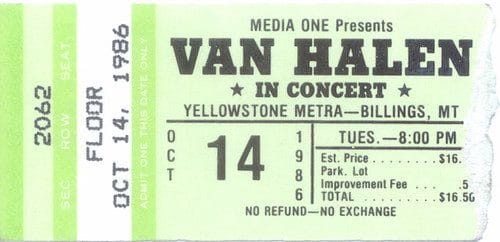
This had important implications, since the show was no longer the classic nightclub or bar concert where they simply set up the equipment and start playing.
These shows had become true logistical operations that required tremendous coordination among everyone involved in the concert.
It’s not just the band members and their crew; these types of concerts also involve organizers, ticketing companies, risk insurance, private security, and many other elements.
It is a self-organized chaos designed so that everything goes well, because it benefits everyone.
And obviously, the risks are many. Anything could go wrong and jeopardize the show.
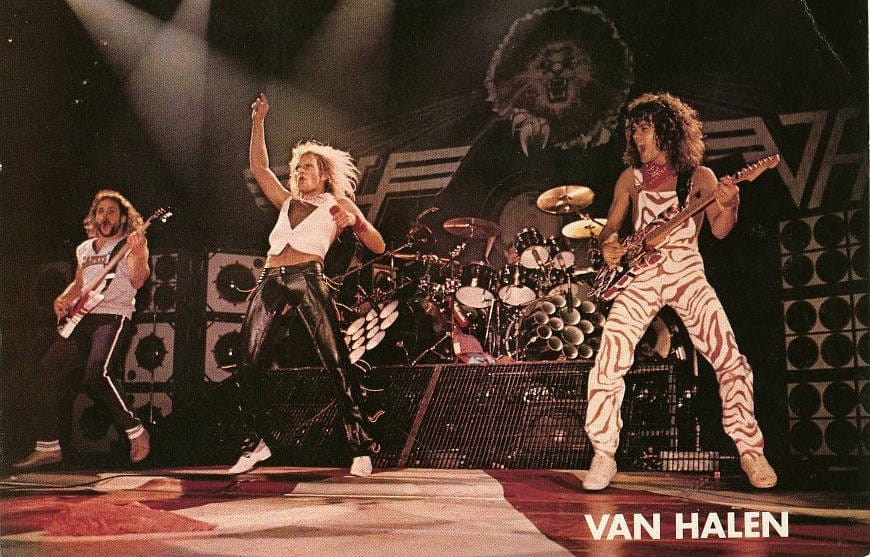
On top of that, Van Halen’s shows were highly pyrotechnic and acrobatic.
There was everything. In the words of David Lee Roth (as quoted here):
We traveled with nine 18-wheel trucks full of equipment to places where the standard was a maximum of three trucks.
And there were many technical problems such as beams that could not support the weight or floors that would sink.
Our rider looked like the Chinese version of the Yellow Pages because of the amount of equipment and human beings needed for everything to work properly.
There were also many things that could go wrong. That is why the band had to protect itself.
Not so much for legal reasons, but for matters of life and death.
Because if something went wrong…
So they devised a special and unique clause to know whether others had done everything properly.
The Van Halen Clause: What Do M&Ms Have to Do With It?

At concerts, it is very common for artists to request snacks or provisions in the dressing rooms such as candy, chips, some food, or anything else.
In Van Halen’s case, there was a special request.
M&M’s (WARNING: ABSOLUTELY NO BROWN ONES)
«What? What kind of eccentricity is this? How spoiled! Typical arrogant rockstars!»
No. What happened is that this clause was a rudimentary way of checking in a simple and direct manner whether the contracts had been read carefully.
It was not a prima donna whim. It was a trap to see whether everything had been read.
What Van Halen members would do was check that bowl, and if it had a single brown M&M they would not perform. The same applied if there was no bowl at all.
This triggered an alert signal to review the entire technical setup, because many times when there were small mistakes there were also serious errors that could endanger the safety of the band and the audience, as happened at the Massari Arena where the floor could not support the weight of the stage and began to sink.
Could Van Halen Refuse to Perform? Wouldn’t That Be a Breach?
Of course they could.
First of all, when one party breaches the contract, such as the party that failed to provide the M&Ms according to the requirement, this allows the non-breaching party to suspend its obligations.
This is called terminating the contract.
In any case, clause 126 also stated that if this requirement was not fulfilled, the concert would be canceled and Van Halen had to be paid in full.

What Can Be Learned from This Clause
Something must be taken into account: this is a form of spontaneous self-organization whose function is one thing, which is to reduce uncertainty and dispersed information.
And it does so in the most logical and common-sense way possible.
When the band arrived to inspect the stage, they had no idea whether things had been done properly or not.
Moreover, checking every aspect separately was too complicated and took too much time.
Finding a brown M&M in a bowl, on the other hand, is much easier.
Based on this, they made an inductive inference and thought: They probably did not read the contract carefully.
And if they failed at such a simple task, they probably failed at the more complex ones too.
If they neglected this, they are careless and probably careless with everything else.
This is pure experience and practical understanding of human behavior.
This gave them enough reason to be suspicious and not want to perform until everything was corrected or not perform at all.
How Small Signals Condense Dispersed and Complex Information
These issues about tacit and dispersed information have been studied by authors such as F.A. Hayek and Michael Polanyi.
The band did not need to have read the complete works of either of them.
This is simply how humans operate to reduce complexity and uncertainty. Van Halen understood this tacitly, and that was all they needed.
It operates in a similar (though not identical) way to prices in economics, since they simplify an immense volume of information.
This clause did something similar: it was a signal that condensed more complex information.
Prices can send several signals: there is scarcity of this product, it is feasible to produce another, there is too much supply of something else, etc.
The brown M&M sent a direct and tacit signal: things were probably not done properly here.
This mobilized the band and saved them from performing a much more complicated process.
This is what later allowed them to discover critical failures in the stage and the organization of the concert.
The only small difference is that without prices it is impossible to rationally coordinate a complex economy.
In Van Halen’s case, they could still check how things were, but it would take too much time.
They needed speed. Something quick, direct, and to the point.
If It Was So Good, Why Didn’t They Do It From the Beginning?
When Van Halen was a starting band, this clause was unnecessary because the system was simple and easy to verify.
Introducing such a meticulous requirement in that context would only have unnecessarily complicated something that already worked well.
The clause appears when the system becomes complex and manually reviewing everything is no longer viable. At that point, a simple signal reduces uncertainty and saves time.
For a small artist, the M&M clause not only provides no useful information, but it also adds friction without any benefit and becomes counterproductive for the purpose of the clause itself: since the clause condenses information in a system, if the system stops being complex, the clause stops making sense.
Especially considering that there are more direct and feasible ways to verify risks in a simpler system.
The Van Halen clause is contingent: useful only when the system becomes complex and direct monitoring is costly.
This explanation is not discrimination against small bands, but rather a matter of necessity and proportionality between the complexity of the system and the contractual instrument used.
Conclusion: Beware of Brown M&Ms
According to this metaphor, what should be done in contracts is to include these kinds of clauses that can serve as signals to transmit and condense complex information in a preventive way.
In other words, they create red flags that something is not going well with what we are doing.
We must take into account that concerts are very complex activities in terms of coordination and execution. We already know this from when we discussed contracts in concerts and the role of the impresario.
These Van Halen clauses are useful for that purpose: to give signals to the parties about the real state of things, not just what appears on paper.
They help reduce uncertainty (is everything properly set up?), coordinate dispersed and hidden information (the platform cannot support the weight of the stage), and reduce complexity (otherwise we would have to review the entire setup to know if something is wrong).
It is part of entrepreneurial ingenuity applied to the contractual field: creating innovative clauses that are not provided for by law.
That is precisely what contract law is for: to be creative and use it with ingenuity.
Van Halen, without being lawyers, gave us a clear example of this.
Subscribe to Our Newsletter to Receive More Articles Like This!
If you have an additional inquiry, contact us below and we will refer you to a professional.